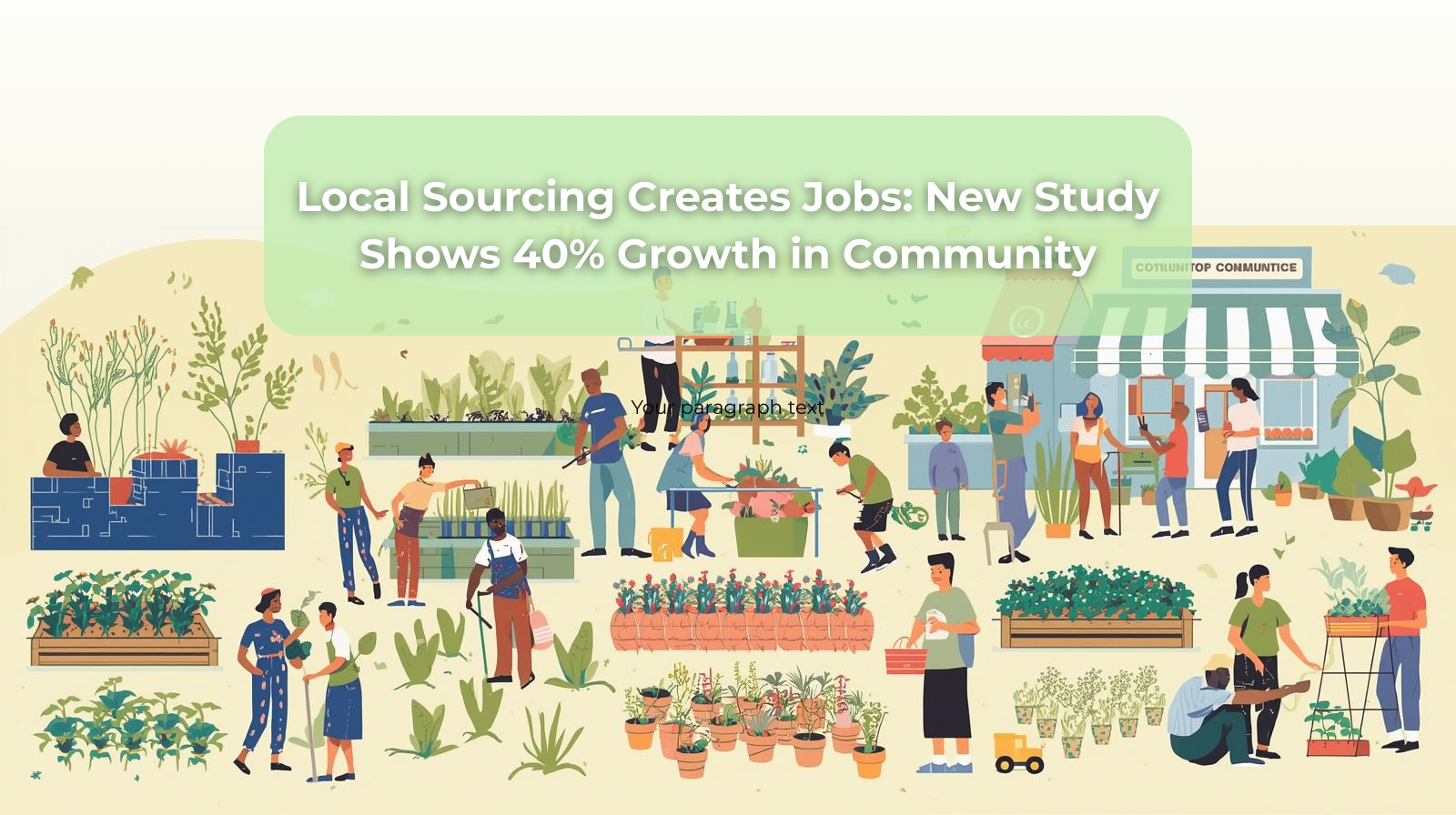

Do you know how local sourcing can transform your entire community’s job market?
Surprisingly, local sourcing creates far more than just convenience and quality – it generates significant employment opportunities. According to a 2024 study by Supplier.io, every dollar paid to a local supplier generated an additional $1.80 in economic activity. Across the 398 organizations studied, that spending created more than 1.4 million jobs, $105 billion in income, and $37 billion in tax revenue.
We’re seeing a major shift in how businesses approach their supply chains. A 2025 survey found that 68% of US manufacturers plan to increase domestic sourcing within the next 12 months—a marked increase over the 54% that planned to do so in 2023. This trend is reshaping local economies across the country.
For many communities, especially in rural or economically challenged areas, manufacturing jobs serve as the backbone for local employment. By creating stable, well-paid jobs, the manufacturing sector helps anchor communities and reduce economic disparities. When businesses source goods and services from nearby suppliers, they play a pivotal role in fostering economic growth within their communities.
In this article, I’ll show you exactly how strategic investments in localized systems can foster economic growth, create quality local jobs, and generate revenues while advancing goals of resilience, equity, and sustainability. You’ll discover the hidden power of local sourcing and how one simple shift in purchasing strategy can revitalize entire communities.
Table of Contents
Key Takeaways
Local sourcing isn’t just about convenience—it’s a powerful economic engine that transforms communities by creating quality jobs and keeping money circulating locally.
• Local sourcing generates 40% more jobs: Every dollar spent with local suppliers creates $1.80 in additional economic activity, supporting 1.4 million jobs nationwide.
• Manufacturing jobs pay 13% more than service roles: Local sourcing creates stable, well-paid positions with better benefits and job security for workers at all education levels.
• Local spending multiplies community wealth: 48% of money spent at local businesses recirculates locally, compared to just 14% at chain stores—tripling economic impact.
• Training partnerships fuel workforce development: Community colleges and manufacturers collaborate to create accessible career pathways, with programs offering up to 50% wage reimbursement during training.
• Tax revenue funds community growth: Local sourcing generates $37 billion in tax revenue annually, directly funding schools, infrastructure, and public services that benefit everyone.
The evidence is clear: choosing local suppliers doesn’t just strengthen your business—it rebuilds entire communities by creating a virtuous cycle of employment, spending, and reinvestment that benefits everyone.
Did You Know Local Sourcing Can Rebuild Entire Communities?
Have you noticed how abandoned storefronts spring back to life in certain communities while others continue to struggle? The answer often lies in where people and businesses spend their money.
The hidden power of buying local
The magic of local sourcing operates through what economists call the “multiplier effect.” For every dollar spent at local independent businesses, approximately 48% recirculates in the local economy, compared to less than 14% when spent at chain stores [1]. This means local independent retailers return more than three times as much money per dollar of sales to the local economy than their chain competitors.
Moreover, when businesses purchase from local suppliers, they generate an additional $1.80 in economic activity for every dollar spent [2]. This remarkable cycle creates a powerful engine for community wealth:
- Local businesses hire local workers
- These workers spend their wages locally
- Local taxes fund community projects
- More entrepreneurs open businesses
- Communities become self-sustaining
Indeed, small-scale, locally owned businesses create communities that are more prosperous across a wide range of metrics [3]. As local businesses thrive, they’re able to hire more employees, provide competitive wages, and offer benefits, consequently strengthening the financial security of neighbors and friends [3].
How one shift in sourcing created 40% more jobs
In Kenya, a simple policy change requiring a percentage of public procurement contracts to be awarded to local suppliers led to a 40% increase in local supplier participation in government contracts [4]. This shift dramatically boosted job creation and local entrepreneurship.
Furthermore, a 2024 study found that across 398 organizations, local sourcing generated more than 1.4 million jobs, $105 billion in income, and $37 billion in tax revenue [2]. This demonstrates how a single strategic decision – prioritizing local suppliers – can transform entire communities.
Consider Ohorongo, Namibia’s first cement producer, which sources all key inputs locally. This single plant supports more than 2,000 indirect jobs through these activities [5]. Similarly, Virú, one of Peru’s largest agricultural exporters, works closely with 275 small-scale suppliers, supporting significant local employment [5].
Why this matters now more than ever
In today’s volatile economic landscape, local sourcing builds resilience against global disruptions. A 2020 study by McKinsey found 40% of companies plan to make their procurement more local to minimize risks [6]. In Europe, about 60% of companies aim to diversify their supply chains to be less dependent on global disruptions [6].
Additionally, local sourcing enhances what sociologists call the “relational economy,” where transactions become conversations and exchanges include stories, knowledge, and mutual recognition [7]. This creates stronger social bonds in a time of increasing isolation.
The impact on community stability cannot be overstated. Local sourcing creates what economists call “sticky money” – wealth that stays in a community instead of leaking away to distant shareholders. Each transaction adds another thread to the community web, strengthening its overall fabric [7].
Local suppliers are also more likely to support other local businesses, creating a virtuous cycle. Small businesses offer 77% more support for local employment and produce a greater number of jobs per consumer [8]. Up to 90% of net new jobs in the U.S. are created by locally owned businesses [3].
Next time you make a purchase decision, remember: your choice of supplier doesn’t just affect your business – it could potentially rebuild an entire community.
How Local Sourcing Creates Stable, Well-Paid Jobs
Have you ever wondered why some towns thrive despite the economy’s ups and downs? The secret often lies in quality jobs – the kind that local sourcing creates.
Entry-level roles in manufacturing and logistics
Ever wanted a good job without a college degree? Manufacturing jobs offer precisely that opportunity. For many communities, particularly in rural or economically challenged areas, manufacturing positions serve as a backbone for local employment [9]. These roles provide accessible entry points for workers with high school diplomas or equivalent certifications [9].
The logistics sector presents another goldmine of opportunities. Employment of logisticians is projected to grow 17 percent from 2024 to 2034, much faster than the average for all occupations [10]. This growth translates into approximately 26,400 openings for logisticians projected each year [10].
Many of these positions require minimal initial training yet offer substantial growth potential. Workers gain technical skills that boost their long-term earning potential. Initially, local sourcing creates demand for warehouse associates, delivery personnel, and production workers – positions that form the foundation of a stable local economy.
Higher wages compared to service-sector jobs
Manufacturing jobs punch above their weight when it comes to compensation. Manufacturing workers earn 13.0 percent more in hourly compensation (wages and benefits) than comparable workers in the rest of the private sector [11].
Despite what some might think, the manufacturing wage premium exists across all education levels:
- High school graduates enjoy a total compensation premium of 11 percent in manufacturing [11]
- Younger workers (ages 25-34) receive a 10.3 percent premium [11]
- Even workers with less formal education earn more in manufacturing than service jobs
In 2024, the median annual wage for logisticians was $80,880 [10], showcasing how local supply chain jobs offer middle-class stability.
Beyond just wages, the benefits in manufacturing roles are exceptional. The manufacturing sector provides better benefits—primarily in insurance and retirement—than service-sector jobs. Remarkably, while the manufacturing wage premium has declined somewhat, the benefits advantage has actually grown between 1986 and 2017 [11].
Job security through long-term supplier contracts
Undoubtedly, one of the most valuable aspects of local sourcing is stability. Manufacturing workers are much less likely to lose their jobs than workers in other sectors [1]. This job security stems from long-term supplier relationships that local sourcing fosters.
Local manufacturers typically secure ongoing contracts with nearby businesses, creating predictable production schedules and stable employment. Furthermore, workers in manufacturing enjoy longer tenures and experience lower separation rates than those in other sectors [8].
The consistency of local supply chains generates what economists call “sticky employment”—jobs that remain in the community even during economic downturns. Essentially, when businesses source locally, they create an interdependent web of employment that’s resilient against outsourcing pressures.
Despite the manufacturing sector’s declining share of total employment (dropping to 15 percent of nonfarm employment compared to 38 percent historically) [1], the quality of these jobs remains superior. For workers seeking stable, well-paid positions that offer growth potential without requiring advanced degrees, local manufacturing and logistics offer unmatched opportunities.
The Ripple Effect: How Local Suppliers Fuel Local Economies
What happens when a dollar spent locally travels from business to business before leaving your community? This “ripple effect” transforms single transactions into waves of economic growth.
Growth of small and medium-sized businesses
Imagine a community where money flows like a river, nourishing every business it touches. This ideal scenario happens naturally through local sourcing.
In reality, our current economic system often directs money away from communities through national chains. However, local sourcing creates a powerful bridge by keeping dollars circulating locally. Small local businesses are the largest employers nationally, creating two out of three new jobs and employing more than 52 percent of the nation’s workforce [3].
The mathematics of local economics proves compelling: when businesses purchase from local suppliers, they generate an additional $1.80 in economic activity for every dollar spent [12]. This remarkable multiplier effect fuels business growth throughout the supply chain.
Small businesses have added more than 5.1 million new jobs to our economy since 2003 [3]. When dollars stay local, they raise the overall level of economic activity, pay more salaries, and strengthen the foundation for new entrepreneurs.
More spending in local stores and services
Ever noticed how some communities seem to have thriving main streets while others struggle? The difference often comes down to where people spend.
For every $100 spent at local independent businesses, approximately $48 recirculates locally, compared to just $16 when spent at non-local businesses [13]. This means local businesses return three times more money per dollar to the local economy than chain competitors.
The recirculation creates a virtuous cycle:
- Local businesses hire local workers
- These workers spend their wages at local establishments
- Local businesses purchase from other local providers
- This cycle repeats, multiplying the original spending
Studies show that 52.9%–64.1% of locally earned revenue recirculates in the local economy [5]. In contrast, when spending at chain stores, only about 43 cents of every dollar remains local, whereas approximately 67 cents stays within the community when spent at local businesses [6].
Increased tax revenue for community projects
Local sourcing generates substantial tax benefits for communities. A 2024 study found that across 398 organizations, local sourcing generated $37 billion in tax revenue [12].
Cities, counties, and towns collect around $886 billion in taxes each year to support vital priorities including education, infrastructure, public health, and safety [4]. Local businesses contribute 60.9% more in state and local tax benefits compared to non-local businesses [13].
This increased revenue directly funds community improvements that benefit everyone—from better schools to improved roads and enhanced public services. Furthermore, 91% of local business owners contribute to their communities through volunteering and donations [3].
When comparing charitable contributions, for every $1,000,000 in sales, one local business contributed $4,000 compared to a chain retailer’s $1,000 [3]. This showcases how the ripple effect extends beyond economics into community support.
Training the Workforce: Education and Skill Development
Ever wondered who trains the talent that powers your local supply chains? As local sourcing grows, specialized training becomes the backbone of success.
Community college partnerships with manufacturers
Community colleges provide ideal pathways into manufacturing careers, offering accessible, affordable options closely aligned with local industry needs [14]. Unlike traditional universities, these institutions can rapidly develop specialized courses in manufacturing to meet emerging demands [15].
Several examples highlight this effective approach. In Ohio, Clark State College offers 14 manufacturing certificates that apply toward advanced degrees [14]. Elsewhere, community colleges maintain business incubators and economic development funds that support startups hiring their students [15].
The most effective partnerships form regional coalitions. The Ohio TechNet Consortium brings together community colleges, technical centers, and universities to address manufacturing workforce needs [15]. Likewise, Arizona’s Advanced Manufacturing Institute unites community colleges with economic development agencies to create programs like Automated Industrial Technology [15].
On-the-job training programs for local hires
On-the-job training provides immediate workforce development while offsetting employer costs. Naturally, this model benefits both businesses and workers. Riverside County’s program reimburses employers for up to 50% of a new hire’s wages during their first 480 hours [16].
First thing to remember, these programs transform training expenses into investments. Sacramento Works offers tax credits to companies meeting certain criteria, with employees trained for up to six months [17]. This approach creates immediate workforce growth specifically aligned with local supply chain needs.
Upskilling workers for modern supply chain roles
Given the rapid evolution of supply chains, existing workers need continuous skill development. Presently, 60% of logistics roles worldwide face transformation through AI and automation, yet only 28% of talent report access to training opportunities [7].
Upskilling creates significant benefits:
- Increased efficiency and innovation
- Cost savings ($4,700 average cost per new hire versus training existing staff) [18]
- Better employee retention (with 30% saying they’d leave due to lack of advancement) [7]
Through strategic upskilling, workers develop critical technical skills like AI, data analytics, and automation management, together with essential leadership abilities including problem-solving and critical thinking [18].
Case Studies: Cities That Thrived Through Local Sourcing
Can real places truly transform through local supply chains? These remarkable case studies prove it’s possible.
Chicago: Local food systems and job creation
The Windy City’s food ecosystem has flourished remarkably, with overall employment growing by 10.39 percent from 2010 to 2020 [19]. What’s even more impressive? The Malt Beverage subcluster experienced a staggering 1,411.43 percent increase, expanding from just 140 employees to 2,116 during this decade [19]. Currently, 82 Malt Beverage companies operate in the Chicago area, with Molson Coors Beverage Company leading the charge [19].
The Local Food and Beverage Processing cluster stands as Chicago’s employment powerhouse, employing 136,925 workers as of 2020 [19]. Historically, food processing has formed the backbone of Chicago’s manufacturing since the 1840s and remains its largest manufacturing segment [20].
Vermont: Ben & Jerry’s and local dairy farms
In Vermont’s dairy landscape, Ben & Jerry’s Caring Dairy program showcases how local sourcing creates mutual benefits. The program works with 50 Vermont farms (plus seven in New York) [2], paying farmers approximately $1.75 extra for each 100 pounds of milk they sell—roughly a 12% price premium [2].
Beyond financial support, Ben & Jerry’s demonstrates environmental commitment through innovative partnerships. For instance, their ice cream plant sends about 6,000 gallons of wastewater weekly to Green Mountain Dairy [21], where it fuels a methane digester generating enough electricity to power approximately 400 homes annually [21].
Conclusion
Have you noticed how local sourcing creates powerful ripple effects throughout entire communities? The evidence speaks for itself. Rather than sending dollars away to distant corporations, businesses that source locally build strong, resilient economies right where we live.
Throughout this article, we’ve seen how strategic local purchasing decisions transform communities. Local sourcing doesn’t just create jobs—it creates quality, stable employment with higher wages than comparable service sector positions. Additionally, these jobs often require minimal initial education while providing substantial growth opportunities.
The math undeniably supports this approach. For every dollar paid to local suppliers, an additional $1.80 circulates through the local economy. This multiplier effect explains why communities with strong local sourcing practices enjoy thriving main streets, better-funded public services, and more entrepreneurial activity.
Still, the benefits extend far beyond simple economics. Local sourcing builds resilience against global disruptions, strengthens social bonds within communities, and creates what economists call “sticky money”—wealth that remains in a community instead of leaking away. Furthermore, the tax revenue generated funds vital community projects from schools to infrastructure.
The case studies of Chicago and Vermont demonstrate these principles in action. Chicago’s food ecosystem flourished with remarkable employment growth, while Ben & Jerry’s partnership with local dairy farms shows how mutually beneficial relationships can sustain both businesses and suppliers.
Next time you make a purchasing decision for your business, remember this: your choice of supplier affects far more than your bottom line. By choosing local suppliers, you participate in rebuilding communities, creating quality jobs, and fostering sustainable local economies. Undoubtedly, local sourcing represents one of the most powerful tools we have for creating thriving communities where everyone can prosper.
Frequently Asked Questions About How Local Sourcing Creates Jobs:
Q1. How does local sourcing contribute to job growth in communities?
Local sourcing significantly boosts job creation, with studies showing it can generate up to 40% more jobs in communities. For every dollar spent with local suppliers, an additional $1.80 in economic activity is created, supporting millions of jobs nationwide.
Q2. What are the wage benefits of jobs created through local sourcing?
Jobs created through local sourcing, particularly in manufacturing, tend to offer higher wages. On average, manufacturing jobs pay 13% more than comparable service sector positions and often come with better benefits and job security.
Q3. How does local sourcing impact the local economy beyond job creation?
Local sourcing has a multiplier effect on the local economy. About 48% of money spent at local businesses recirculates within the community, compared to only 14% at chain stores. This leads to increased local spending, business growth, and tax revenue for community projects.
Q4. What role do educational institutions play in supporting local sourcing initiatives?
Community colleges and technical institutions often partner with local manufacturers to develop specialized training programs. These partnerships create accessible career pathways and help build a skilled workforce tailored to local industry needs.
Q5. Can you provide an example of a successful local sourcing initiative?
A great example is Ben & Jerry’s Caring Dairy program in Vermont. The company works with 50 local farms, paying them a 12% price premium for their milk. This initiative not only supports local dairy farmers but also contributes to environmental sustainability through innovative waste management practices.
References
[1] – https://www.bls.gov/opub/mlr/1998/02/art3full.pdf
[2] – https://www.vermontpublic.org/vpr-news/2020-08-25/marketing-or-meaningful-change-ben-jerrys-caring-dairy-pays-farmers-a-premium
[3] – https://ced.msu.edu/upload/reports/why buy local.pdf
[4] – https://itep.org/how-local-governments-raise-revenue-2024/
[5] – https://blog.constellation.com/2025/07/30/local-sourcing-benefits/
[6] – https://www.revfcu.com/the-ripple-effect-how-buying-local-creates-resilient-communities/
[7] – https://www.staffingindustry.com/news/global-daily-news/most-logistics-jobs-face-ai-shift-but-workers-lack-training
[8] – https://www.federalreserve.gov/econres/feds/files/2022011pap.pdf
[9] – https://jarctraining.org/how-manufacturing-supports-local-economies/
[10] – https://www.bls.gov/ooh/business-and-financial/logisticians.htm
[11] – https://www.epi.org/publication/manufacturing-still-provides-a-pay-advantage-but-outsourcing-is-eroding-it/
[12] – https://www.netsuite.com/portal/resource/articles/erp/local-sourcing.shtml
[13] – https://golocal.coop/olivers-market-local-economic-multiplier-analysis/
[14] – https://givingcompass.org/article/community-colleges-partner-with-local-manufacturers-to-train-workers
[15] – https://www.ccdaily.com/2025/10/linking-economic-development-with-workforce-development/
[16] – https://rivcoworkforce.org/district-3-programs
[17] – https://sacworks.seta.net/program/on-the-job-training-for-local-employers-and-contractors/
[18] – https://www.ascm.org/ascm-insights/what-supply-chain-leaders-need-to-know-about-upskilling-and-reskilling/
[19] – https://voorheescenter.uic.edu/news-stories/food-for-thought-new-report-explores-chicagos-food-ecosystem/
[20] – https://www.chicago.gov/content/dam/city/depts/zlup/Sustainable_Development/Publications/Eat_Local_Live_Healthy_Brochure/Eat_Local_Live_Healthy.pdf
[21] – https://www.usdairy.com/news-articles/ice-cream-helps-dairy-farm-put-energy-on-the-grid