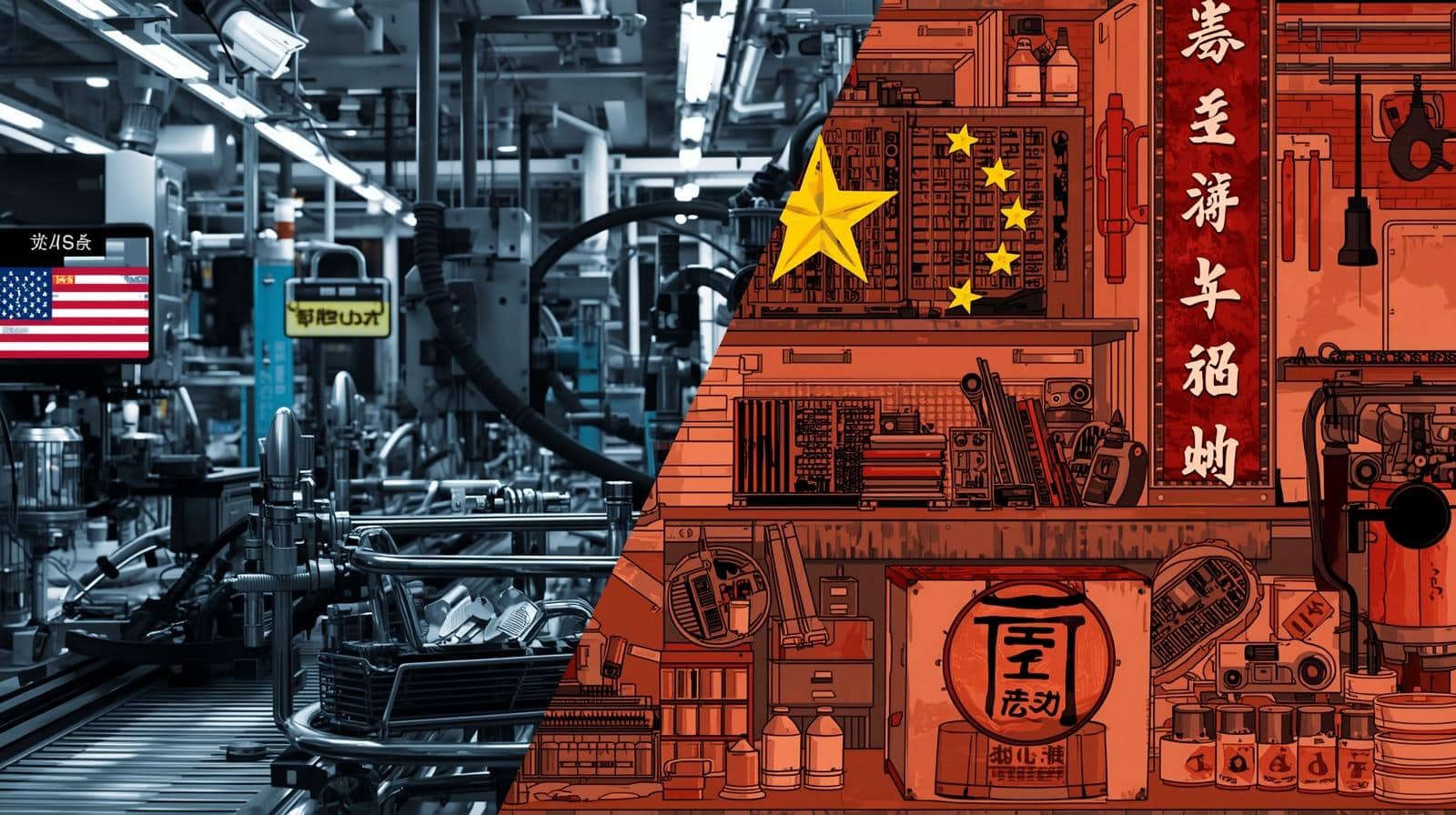

Do you know the real quality differences between manufacturing in China versus the USA in 2025? When comparing manufacturing in China with American production, we’re looking at two global powerhouses with distinct advantages. China remains the world’s largest manufacturer, surpassing the US in terms of output value and volume. However, this doesn’t tell the whole story. Understanding the nuances of made in usa vs. made in china is essential for informed decision-making.
For businesses like yours, choosing where to manufacture involves weighing several factors. While manufacturing companies in China offer labor costs up to 70% less than in the US, American factories excel in precision, innovation, and stringent quality control. Is everything made in China? Not quite. The US still dominates high-value manufacturing sectors, especially as shipping from China to US West Coast now takes around 32 days, and to the East Coast about 54 days. These logistics challenges, combined with China’s access to over 1.3 billion potential consumers, create a complex decision-making landscape.
In this comprehensive guide, we’ll break down the key differences in quality standards, technology adoption, and cost structures between these manufacturing giants. By the end, you’ll have a clear picture of which country’s manufacturing approach aligns best with your specific product needs.
Understanding the differences in quality, efficiency, and compliance is crucial when evaluating Made in USA vs. Made in China. When discussing Made in USA vs. Made in China, labor costs and quality control are significant factors that cannot be ignored.
This article will further elaborate on Made in USA vs. Made in China, highlighting critical factors that impact your manufacturing strategy.
Table of Contents

Core Manufacturing Strengths: What Each Country Does Best
This post will explore the implications of made in USA vs. Made in China, helping you navigate your manufacturing choices effectively.
Ever wondered why certain products come with “Made in USA” tags despite China’s manufacturing dominance? The answer lies in each country’s unique manufacturing strengths.
US: Innovation, compliance, and high-precision sectors
America excels in high-precision, innovative manufacturing that demands technical excellence. The US ranks fourth in manufacturing growth among top 10 manufacturing nations for value added and maintains leadership in advanced sectors where quality standards are non-negotiable.
The ongoing debate of Made in USA vs. Made in China continues to influence consumer preferences globally.
What makes US manufacturing special? First, it dominates industries requiring strict regulatory compliance and innovation speed. This creates a powerful advantage in aerospace, medical instruments, and defense sectors. Second, US manufacturing leads in rapid prototyping and bridge production—critical for companies needing fast design iterations.
US manufacturers focus heavily on automation to drive quality and compliance. A remarkable 70% of factories have adopted smart manufacturing technologies, integrating AI and machine learning into production workflows. This technological edge enables precision impossible to match at lower price points.
Furthermore, America’s manufacturing economy alone would rank as the eighth-largest country globally if measured independently. This economic strength provides stability and resources for continued innovation.
China: Speed, scale, and cost-effective production
China has transformed from an agricultural economy to the world’s leading manufacturer, producing approximately 30% of all global manufacturing output in 2022. Manufacturing companies in China thrive because of three unmatched strengths:
- Cost efficiency: Labor costs in China (around $6.50/hour) remain significantly lower than in the US ($28/hour) or Germany ($47/hour). This creates substantial cost advantages even with rising wages.
- Unparalleled scale: China combines low labor costs with enormous production capacity. Foxconn’s Zhengzhou complex, for instance, produces 500,000 iPhones daily with 1.4 million workers.
- Infrastructure superiority: China possesses the world’s largest high-speed rail network (42,000+ km), world-class ports like Shanghai (handling 47 million TEUs yearly), and mega-industrial parks in cities like Shenzhen.
Additionally, Chinese factories offer remarkable flexibility. Over 60% of Chinese manufacturing SMEs provide customized production services, enabling rapid adaptation to changing market demands.
Is everything made in China? Not quite—here’s why
Despite China’s manufacturing dominance, the United States retains leadership in several critical sectors. Indeed, America remains the world’s top service exporter with nearly $1 trillion in service exports and a $300 billion trade surplus.
The US maintains commanding positions in high-value industries. American companies dominate information technology and services (36% of global production), other transportation (35%), and pharmaceuticals (28%). These sectors require sophisticated technological capabilities that aren’t easily replicated.
Moreover, certain products face export controls that mandate domestic manufacturing by US persons to comply with regulatory requirements. This creates natural protection for sensitive industries with dual-use applications.
Consequently, the manufacturing landscape isn’t simply about China versus US but understanding each country’s distinct advantages based on your specific product needs.
Quality Control Systems: Standards, Testing, and Trust
This analysis of Made in USA vs. Made in China will assist you in making informed decisions.
Have you ever wondered why some products from China face quality issues while others match or exceed American standards? The answer lies in the fundamentally different quality control systems each country employs.
Certifications: ISO vs CCC and global alignment
When examining product certifications, China relies primarily on its China Compulsory Certificate (CCC) system, established in 2002 as a mandatory safety assessment procedure for products sold in China. Unlike the American system, CCC certification requires product testing specifically in Chinese laboratories, an initial factory audit, and subsequent annual follow-up inspections.
In contrast, American manufacturers typically follow ISO standards alongside a more continuous improvement approach. The US system aligns closely with international standards, whereas Chinese manufacturers must navigate a dual path—meeting both domestic CCC requirements and international standards to export effectively.
Testing methods: Process control vs final inspection
The most striking difference between quality approaches in both countries is their testing philosophy:
- US approach: Emphasizes process control—a proactive system focusing on preventing defects throughout production rather than just detecting them afterward. This methodology aims to monitor and stabilize production in real-time, reducing variation and improving consistency.
- Chinese approach: Traditionally relies more on final inspection—a reactive process examining finished products to catch defects after they’ve occurred. This approach focuses on identifying existing problems rather than preventing them from happening.
According to industry data, companies implementing process control experience 40% increases in customer loyalty compared to those relying solely on inspection. This difference explains why American manufacturing excels in precision industries requiring zero defects.
Brand reputation: How quality perception shapes decisions
Quality control directly impacts how customers perceive brands. Consistent quality builds trust, which serves as the cornerstone of positive brand reputation. When manufacturers deliver products that consistently meet expectations, they establish credibility among customers.
Notably, quality control acts as a safeguard against reputational risks. For manufacturers in both countries, maintaining high standards consistently reinforces their brand promise. This explains why some Chinese manufacturers have invested heavily in improving quality systems—they recognize that in today’s interconnected world, consumer opinions spread rapidly through social media and online reviews.
The geographical distance from Chinese factories creates additional challenges for American companies, often leading to costly quality issues due to limited direct oversight. This reality underscores why understanding each country’s quality approach remains essential for making informed manufacturing decisions.
Technology and Automation: Smart Factories in 2025
Can you guess which country installed nearly 10 times more industrial robots than the other in 2024? The gap in smart factory adoption between the US and China is widening rapidly, with profound implications for global manufacturing.
Industry 4.0 adoption: AI and IoT in US vs China
In 2024, China installed a staggering 300,000 industrial robots—nearly 10 times the 34,000 units deployed in America. First, this massive automation surge has propelled China to become the world’s third-most automated nation with 470 robots per 10,000 manufacturing employees.
In the context of brand perception, Made in USA vs. Made in China plays a pivotal role in customer choices. Choosing between Made in USA vs. Made in China can significantly affect your business’s market positioning.
The adoption drivers differ dramatically between nations. American manufacturers primarily automate to offset high labor costs and achieve faster time-to-market. Essentially, US factories employ AI to optimize designs, predict supply chain issues, and enable sophisticated predictive maintenance.
Conversely, China’s automation push stems directly from government initiatives. Even though labor remains relatively inexpensive in China, state directives have accelerated automation to maintain global competitiveness. Interestingly, 57% of robots installed in Chinese factories now come from domestic manufacturers, up from just 28% a decade ago.
CNC and 3D printing: Customization and prototyping
Both nations leverage advanced manufacturing technologies differently. For prototyping electronics enclosures, American companies typically use:
- FDM 3D printing for rapid, cost-effective early iterations
- SLS 3D printing for better accuracy without support structures
- CNC machining for high-precision, professional-finish prototypes
Chinese manufacturers, meanwhile, excel at scaling these technologies for mass production. Therefore, when a product moves from prototype to production, manufacturing companies in China can quickly implement customized production services, with over 60% of Chinese SMEs offering such flexibility.
Government initiatives: CHIPS Act vs Made in China 2025
The CHIPS and Science Act represents America’s most significant industrial policy action. Simultaneously, China’s Made in China 2025 initiative identified robotics as critical for achieving technological self-sufficiency.
Above all, these approaches reflect fundamental philosophical differences: the US targets specific strategic sectors like semiconductors, while China pursues comprehensive industrial dominance across multiple technologies. By 2025, the smart factory market in the US is projected to reach €68 billion, while China and Germany will each cross the €12 billion mark.
Currently, China has already met or exceeded many of its ambitious technology development targets set in 2015. The country’s operational stock of industrial robots has surpassed 2 million—five times larger than America’s inventory. This automation gap continues to expand as Chinese manufacturers boost productivity through technology integration.
Supply Chain and Logistics: Proximity vs Ecosystem
Why do supply chain executives report that 76% of businesses are drawing their supply chains closer to the Americas in 2025? The answer lies in the fundamental difference between proximity and ecosystem advantages in global manufacturing.
Supplier networks: Dense clusters in China
China’s manufacturing power comes from its remarkable supplier density. Over 2,000 industry clusters exist across China, primarily in eastern and central provinces. These clusters create powerful synergies where:
- A single product might have components from a dozen specialized suppliers within a 50-kilometer radius
- Vertical integration and local sourcing dramatically reduce lead times
- Knowledge and talent flow freely between companies, driving innovation
This ecosystem approach explains why many retailers struggled to move production out of China during trade tensions. Attempts to relocate to Vietnam or Cambodia worked only for basic products like simple clothing items, as alternatives lacked the integrated supplier networks China offers.
Shipping and customs: Cost and time trade-offs
Shipping between China and the US became increasingly complex following trade tensions. Container booking systems became saturated, port facilities experienced overload, and processing times for goods grew significantly longer. Consequently, freight costs increased primarily because of:
- Less available vessel capacity
- Higher operational risk for carriers
- Longer and less direct routes
In response, executives report that the volatile global trade environment is forcing 61% of businesses to refocus on regional and domestic sourcing and distribution. Strategic shoring allows companies to reduce lead times, diversify supply, maximize talent access, and minimize risk.
Inventory management: Predictability vs scalability
The ideal supply chain situation offers both predictability and scalability. In reality, businesses must often choose between them.
US supply chains typically prioritize predictability—making inventory management more stable but potentially less flexible. Chinese manufacturing, alternatively, excels at scalability through its dense ecosystem, allowing rapid production increases when needed.
For companies needing both attributes, collaboration experience becomes crucial for ecosystem formation. Firms with higher-performing supply chains recognize the importance of navigating both the tax and regulatory landscape, with 53% saying regulators and tax officials significantly influence strategic shoring decisions.
As we move through 2025, the choice between proximity and ecosystem advantages remains a critical decision point for global manufacturers seeking the optimal balance between cost, speed, and reliability.
Legal and IP Protection: Risk vs Regulation
What happens to your intellectual property when manufacturing overseas? In an ideal world, your designs, patents, and trademarks would be universally protected. Yet in reality, legal systems vary dramatically between the US and China.
IP laws: Enforcement in US vs evolving rules in China
IP infringement remains widespread in China, forcing businesses to take proactive protection measures before entering the market. Although China has strengthened its IP regulations as a signatory to several international agreements, enforcement remains inconsistent.
In the US, IP enforcement primarily operates through federal courts with predictable procedures. Conversely, China offers both judicial and administrative enforcement paths, with the latter sometimes providing faster resolution.
The most striking difference? American courts offer robust “discovery” allowing you to demand evidence from the other side, whereas Chinese courts require you to collect hard evidence yourself, often through private investigations.
Patent registration: Why dual protection matters
China offers a unique “both-filing” or dual filing strategy unavailable in America. This approach allows simultaneous filing of invention and utility model patent applications for the same product.
Through this strategy, manufacturers gain quick protection via a utility model patent (typically within one year) plus potential long-term protection through an invention patent (valid for twenty years). This dual approach provides crucial legal support for production and marketing while reducing the protection gap before invention patents are granted.
Dispute resolution: Arbitration vs litigation
For resolving commercial disputes, businesses can choose between arbitration and litigation. Arbitration typically concludes within seven months, whereas litigation averages 23-30 months.
Arbitration offers several advantages over litigation:
- Lower costs due to limited discovery
- Simpler, more convenient process
- Private proceedings that protect trade secrets
- Generally faster resolution
The primary disadvantage? Unlike litigation, arbitration decisions are typically binding with minimal opportunity for appeal unless you can prove bias or fraud.
Conclusion
Are you still wondering which country truly offers the best manufacturing option for your specific business needs?
Ultimately, the choice of made in usa vs. made in china should align with your long-term business goals. For many consumers, the dilemma of made in usa vs. made in china remains a critical topic. The comparison of Made in USA vs. Made in China can greatly influence sourcing decisions.
Throughout this analysis, we’ve seen how China and USA bring distinct advantages to global manufacturing. China provides lower labor costs, massive scale, and dense supplier networks. The US, on the other hand, stands out with precision manufacturing, strict quality controls, and stronger IP protection.
Your ideal manufacturing decision depends largely on what matters most for your product. If cost efficiency and scale drive your business, Chinese manufacturing likely offers better value. Conversely, if regulatory compliance, innovation speed, and quality consistency are non-negotiable, American production serves you better.
Additionally, supply chain considerations have shifted dramatically since 2020. While China’s manufacturing ecosystem remains, proximity advantages of US production grow increasingly valuable as shipping times and costs rise. The 32-54 day shipping timeline from China significantly impacts inventory management and customer satisfaction.
Therefore, the best approach often combines strengths from both countries. Many successful businesses now use American facilities for high-precision components or initial production runs while leveraging Chinese manufacturing for cost-effective scale. Subscribe to our newsletter for more insights on global manufacturing trends, comparative analyzes, and expert guidance on navigating production decisions between the US and China.
After all, the manufacturing landscape continues evolving rapidly. The automation gap widens as China installs nearly ten times more industrial robots than America. Meanwhile, US companies push technological boundaries with AI and machine learning integration. Understanding these shifts helps you make smarter production choices aligned with your specific quality requirements, budget constraints, and market demands.
FAQs
Q1. What are the main differences in manufacturing quality between China and the USA? The USA excels in high-precision manufacturing, innovation, and regulatory compliance, while China offers cost-effective production at scale. US manufacturing focuses on process control throughout production, whereas China traditionally relies more on final inspection.
Q2. How do labor costs compare between China and the USA? Labor costs in China are significantly lower, at around $6.50 per hour, compared to approximately $28 per hour in the USA. This cost difference contributes to China’s competitive advantage in manufacturing.
Q3. Which country has a higher adoption rate of industrial robots? China has a much higher adoption rate of industrial robots. In 2024, China installed about 300,000 industrial robots, nearly ten times more than the 34,000 units deployed in the USA.
Q4. How do supply chains differ between China and the USA? China has dense supplier networks with over 2,000 industry clusters, offering ecosystem advantages. The USA focuses more on proximity and regional sourcing, prioritizing predictability in inventory management.
Q5. What are the key considerations for intellectual property protection when manufacturing in China versus the USA? The USA has strong IP laws with predictable enforcement, while China’s IP regulations are evolving with inconsistent enforcement. China offers a unique dual patent filing strategy, but businesses need to take proactive measures to protect their IP when manufacturing there.
References
[1] – https://medium.com/@paulinaannaszyzdek/how-chinas-automation-surge-is-redefining-global-manufacturing-561c50d2da65
[2] – https://supplychaindigital.com/supply-chain-risk-management/kpmg-proximity-the-new-value-driver-for-supply-chains
[3] – https://insight-quality.com/quality-of-products-made-in-china/
[4] – https://kpmg.com/us/en/media/news/proximity-premium-2024.html
[5] – https://www.csis.org/analysis/beyond-manufacturing-why-services-are-key-us-china-economic-competition
[6] – https://www.aerodoc.com/implications-supply-chain-following-latest-us-china-trade-truce/
[7] – https://www.china-certification.com/en/what-is-ccc/
[8] – https://www.vegascg.com/blog/inspection-vs-process-control/
[9] – https://axonator.com/blog/differences-between-inspection-and-control/
[10] – https://www.linkedin.com/pulse/inspection-vs-process-control-ensuring-quality-every-stage-khanepaz-vkbaf
[11] – https://www.agilitypr.com/pr-news/branding-reputation/brand-reputation-in-focus-why-it-matters-what-factors-impact-it-how-to-measure-it-and-how-it-drives-success/
[12] – https://eoxs.com/new_blog/the-impact-of-quality-control-on-brand-reputation/
[13] – https://stplastics.com/protecting-your-investment-quality-control-intellectual-property-in-china-vs-u-s/
[14] – https://www.mmh.com/article/manufacturing_in_the_usa_vs._china_ai_could_be_the_tipping_point
[15] – https://www.rockwellautomation.com/en-us/company/news/the-journal/8-key-industrial-automation-trends-in-2025.html
[16] – https://www.abiresearch.com/blog/using-ai-tip-industrial-manufacturing-scale-china-vs-usa
[17] – https://www.hubs.com/knowledge-base/3d-printing-vs-cnc-machining/
[18] – https://www.aei.org/research-products/report/does-the-chips-and-science-act-argue-for-industrial-policy/
[19] – https://www.sciencedirect.com/science/article/pii/S2667111524000227
[20] – https://www.i-scoop.eu/industry-4-0/smart-factory-investments/
[21] – https://www.uscc.gov/research/made-china-2025-evaluating-chinas-performance
[22] – https://www.china-briefing.com/news/chinas-industry-clusters-comprehensive-overview/
[23] – https://www.maplesourcing.com/introduction-to-key-manufacturing-hubs-of-china.html
[24] – https://www.amrepmexico.com/blog/manufacturing-cost-comparison-china-thailand-india
[25] – https://www.ykfreight.com/blog/how-the-us-china-trade-war-affects-shipping-costs-and-retail-prices/
[26] – https://www.sciencedirect.com/science/article/pii/S0040162523006029
[27] – https://www.trade.gov/country-commercial-guides/china-protecting-intellectual-property
[28] – https://shieldworksmfg.com/is-china-ip-safe-for-manufacturing-everything-you-need-to-know/
[29] – https://patentpc.com/blog/key-differences-in-ip-enforcement-across-the-us-eu-and-china
[30] – https://afdip.com/insights/Articles/Patent/2024/1023/396.html
[31] – https://legal.thomsonreuters.com/blog/arbitration-vs-litigation-the-differences/